
by Anna Jewell, Chair of the Less Survivable Cancers Taskforce
Following Less Survivable Cancers Awareness Week 2026, I wanted to reflect on the fantastic impact of a week of action across the UK. This year, the Taskforce came together around a clear and urgent message: we must #CloseTheResearchGap.
Less survivable cancers – cancers of the brain, liver, lung, oesophagus, pancreas and stomach – continue to account for a devastating proportion of cancer deaths, yet they remain chronically under-researched. This awareness week helped shine a much-needed spotlight on that inequity and I want to thank everyone who supported the campaign: our member charities, parliamentarians across the four nations, clinicians, researchers, industry partners, and, above all, people affected by these cancers who are at the forefront of our work as a Taskforce.
The scale of the research gap
New analysis released during the week, based on Freedom of Information requests, revealed the true scale of the research funding gap. Despite accounting for nearly 40% of all common cancer deaths, less survivable cancers receive just 18.92% of government-funded cancer research.
In practical terms, this means that, on average, less survivable cancers receive around £130 less in research funding per cancer death compared to the average across all cancers. For some cancers, the situation is even worse: oesophageal cancer receives as little as £40 per death, compared to an average of £310.
With more than 95,000 people diagnosed with a less survivable cancer every year in the UK, it is simply not acceptable that these cancers continue to be left behind. Research is fundamental to improving survival — yet the current system continues to disadvantage the cancers where progress is most urgently needed.
Driving change across the UK
Awareness Week saw strong parliamentary engagement across all four nations.
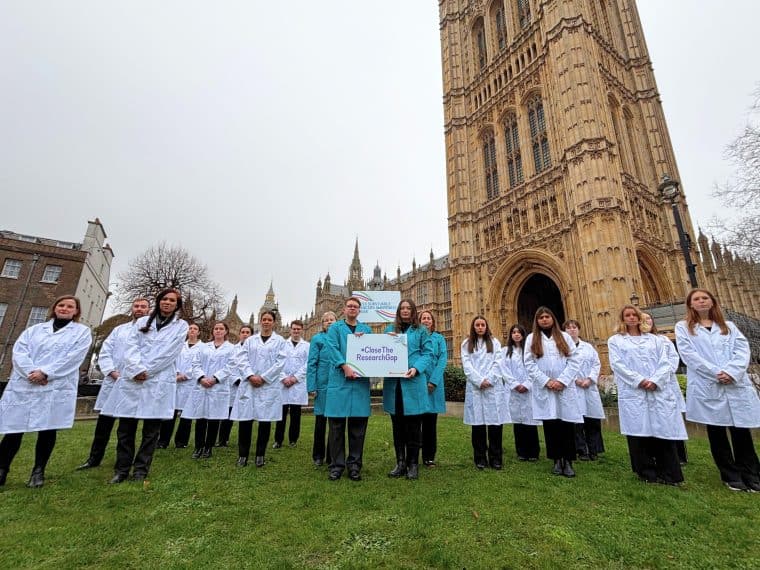
- In England, we held a stunt in Westminster calling on government to #CloseTheResearchGap. An Early Day Motion was also tabled by Paulette Hamilton MP to highlight the campaign and the newly released research funding data, which received cross party support.
- In Wales, the Taskforce hosted an event in the Senedd sponsored by Delyth Jewell MS, who also tabled a Statement of Opinion. John Griffiths MS delivered a 90-second statement in the chamber highlighting the urgent need for action on less survivable cancers.
- In Scotland, the Taskforce held an event at Holyrood sponsored by Jackie Baillie MSP, which included presentations from leading researchers working on less survivable cancers, alongside a parliamentary motion in support of the campaign.
- In Northern Ireland, the campaign was raised in the Assembly by Stewart Dickson MLA through a statement highlighting the urgent need to #CloseTheResearchGap.
In addition to this, we had strong media engagement and social media presence throughout the week. An example of this is patient advocate, Heulwen Wyatt, who powerfully talked about her experience with oesophageal cancer, and the need to improve outcomes for less survivable cancers in an interview to ITV News.
Together, these activities helped ensure that the call to prioritise less survivable cancers was heard by policymakers across the UK.
Turning momentum into progress
This year’s campaign has once again shown the power of collective action, but it has also reinforced how urgent the challenge remains. If we are serious about improving survival for the least survivable cancers, we must remove barriers to research and ensure funding is directed to where the need is greatest.
The Taskforce will continue to work with governments, parliamentarians, researchers and our partners across the UK to turn this momentum into lasting change. The progress of the Rare Cancers Bill through its final legislative stages also gives real cause for optimism, offering a vital opportunity to transform how rare and less survivable cancers are prioritised and researched. This is a crucial step in ensuring we can start to shift survival rates for these cancers and close the #DeadlyCancerGap.
Thank you again to everyone who supported Awareness Week 2026.
Anna Jewell, Chair of the Less Survivable Cancers Taskforce